Roof Painting Hamilton: The Small Details Decide the Job
The thing that finishes a roof coating early is usually about the size of a coin. A fastener that has climbed a few millimetres out of the purlin. A rust spot tucked under a side lap. A sealant bead at a flashing that went hard one summer and split the next. Roof painting in Hamilton is won or lost on those, and none of them turn up in a finished photograph.
Which is awkward at quote stage, because small details are what a thin quote leaves out. Cleaning and two coats is easy to price. Two dozen failed fasteners and a corroded lap is not.
So here is the detail side of a metal roof repaint, in the order a sensible crew deals with it. The main example is an ageing metal roof in Claudelands.
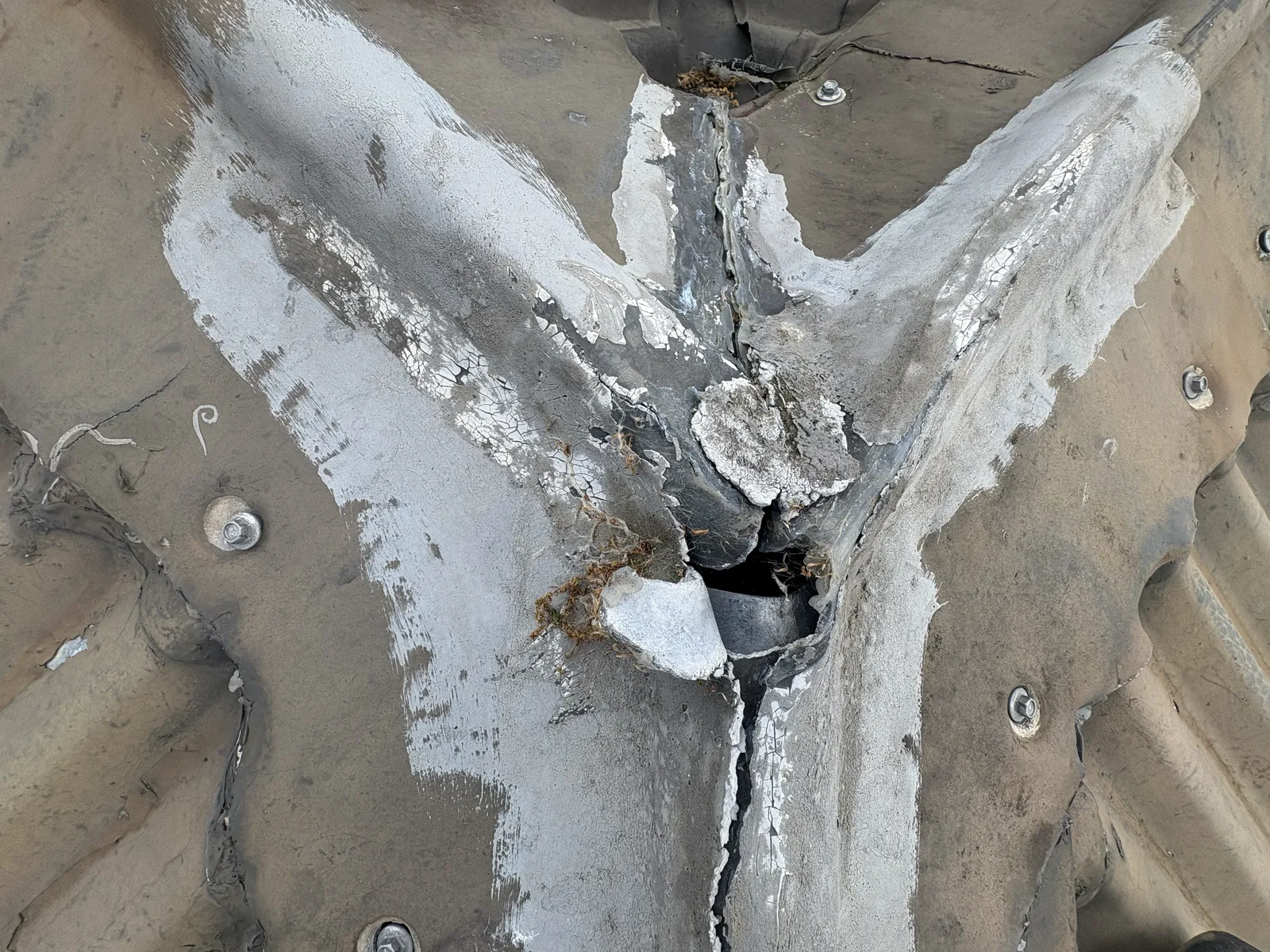 |
| Claudelands metal roof detail before repair, showing a failed junction and fixings needing attention. |
Fixings decide more than the colour does
A metal roof is never still. Sheets grow in afternoon sun and pull back overnight, and season after season that movement works fasteners loose. A lifted head leaves a shallow gap that collects water and grit, and the film around it cracks.
Coating over a fastener that still moves buys a tidy photograph and very little else. The new film splits at that spot, and it splits early.
Nails that have climbed
Older long-run and corrugated roofs were often nailed down. Once a nail has worked its way up, tapping it back rarely holds, because the hole it came from is worn oversize. The answer is to pull it and drive a screw in its place, so the fixing bites fresh timber and the washer seats flat.
Screws that have given up
Screws age too. Washers perish, heads corrode, and a few were probably overdriven the day the roof went on. On the Claudelands job, screws that had deteriorated came out during preparation rather than being treated as an extra once the wash was finished. The Claudelands roof project notes carry photographs of the fixing detail and of the surface afterwards.
If a roof quote says nothing at all about fasteners, ask about it before signing.
Rust: serviceable steel, or steel that is done
Owners want a yes or no on rust, and the truthful answer is a test rather than a rule. Rust sitting in patches can be cleaned back and primed, provided the metal underneath still has enough left in it to be worth protecting. That is ordinary preparation, and it is what happened in Claudelands alongside the fasteners.
Perforation sits on the other side of the line. Once the steel has gone through, or a lap has corroded apart, the job starts with roofing repairs. Paint does not make a roof weathertight; that was never its job.
Between the two sits the roof where rust has spread beyond patches and across a whole slope. That one needs a proper look from safe access before anyone quotes a recoat at all.
Gaps, laps and the junctions water actually uses
Water rarely attacks the middle of a sheet. It goes for the joins: side and end laps, ridge and barge details, valleys, and the collars around vents, aerials and solar mounts. That is where an opening appears or a sealant bead cracks.
In Claudelands the gaps picked up during the inspection were closed before any primer went on. That order matters: a repair made afterwards sits on top of the coating system instead of inside it.
An active leak, a ceiling mark that grows after heavy Waikato rain, or a flashing that has clearly shifted, is a roofing conversation, and it comes before any painting programme.
One caution, though the rest of this is about long-run steel: on older stone-chip tiles the coating itself can carry asbestos, so the surface must be assessed and cleared before anything touches it, and a water blaster is never the tool for it. WorkSafe sets out that check.
Protection goes up before anything is sprayed
Preparation covers more than the roof. Spouting, downpipes, joinery, paths, planting and anything carrying a solar array need covering or masking first. In Claudelands the spouting and everything around the roof was covered before application started.
Cleaning also pushes a surprising amount of grit and old film into the spouting, and clearing that out is part of the job rather than a favour.
What roof painting in Hamilton looks like once the details are sorted
Only now does colour come into it. Prepared bare and rusted areas take a primer suited to the steel and to whatever sound coating is staying, then the specified finish coats follow. In Claudelands that sequence gave an even roof colour instead of a patchwork of repairs.
Weather still gets a vote. The product data sheet sets the limits: how cold is too cold to start, how long between coats, and what the surface must be doing before the next one. Waikato stretches all of it, with fog sitting until mid-morning through winter and dew arriving from late afternoon. Touch-dry means very little on its own, and nothing gets coated while the roof is wet. A scope for roof painting Hamilton is far easier to judge when repairs sit on their own lines, kept apart from the coating system.
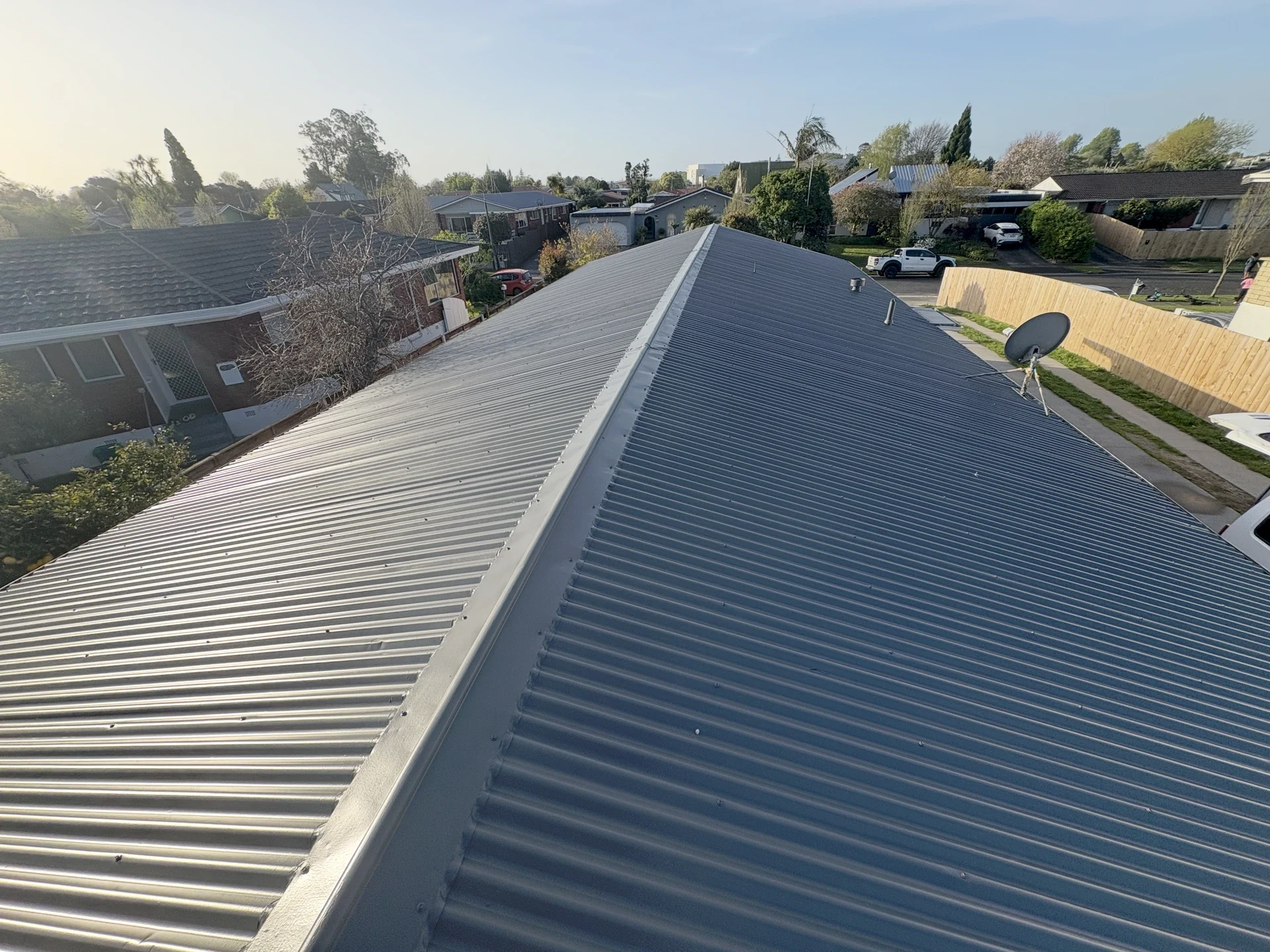 |
| The finished metal roof coating on the same Claudelands roof. |
When the roof is one line in a larger exterior
Sometimes the roof is not the whole job. On a Rototuna home, metal roof, stucco walls and aluminium joinery sat inside one exterior scope, each surface keeping its own preparation and its own compatible coating. Adhesion on the joinery got particular attention, windows were masked, and coating stages were ordered around preparation and drying. The Rototuna roof and exterior write-up shows one programme covering three quite different surfaces.
What you can check from the ground
Stay down here. A roof is no place to satisfy curiosity, and nothing here needs height to spot.
- Rust streaks running down from fasteners, laps and flashing edges
- Patches where the primer, or the steel itself, has become visible
- Chalky, uneven colour, generally worst on the north and west slopes
- Moss and lichen holding on the shaded side and in the valleys
- Coating flakes and grit collecting in the spouting after a storm
- New marks on a ceiling after a downpour, which say leak rather than worn coating
Our guide to reading a roof from the driveway goes through those in more detail. Two photographs do the rest: one of the whole roof, one of the ugliest patch. The suburb pages list what else helps, for example https://hamilton.tomarcontracting.co.nz/dinsdale-painters.html.
FAQ
What should a roof quote say about fixings?
It should say who checks them, what happens to any that have failed, and whether replacement sits in the price or gets charged on top. Nails that have climbed are normally replaced with screws, and deteriorated screws are swapped out during preparation. A quote silent on fasteners is not really comparable with one that covers them.
Does the spouting have to come off before a roof is painted?
No. It is normally protected where it is, along with downpipes and everything below, then cleared of the grit and flakes that wash out during cleaning. Removing it is roofing work, and only comes up where it needs replacing anyway.
How do I know whether a gap at a flashing is a painting job or a roofing job?
If the flashing is sound and the problem is a hardened sealant bead or a small opening at a junction, it is normally handled during preparation. If the flashing has lifted, corroded or is letting water past, that is roofing work and it comes first. An inspection from safe access separates the two.
Roof, exterior and interior work around the city is handled by Tomar Contracting Limited – Hamilton & Waikato, whose base is 59 Boundary Road, Claudelands, and whose patch covers Hamilton itself plus Ngāruawāhia, Morrinsville, Cambridge and Te Awamutu. Weekdays from 9 am to 5 pm, 0800 866 272 reaches the office, and ground-level photographs with a suburb are plenty to get a site assessment organised. Tomar Contracting Hamilton carries photographs from other roofs finished around the district.


Comments
Post a Comment