Roof First or Walls First: Commercial Painters in Hamilton
Most exterior programmes on a business property run in the same order, for a reason. The roof and the water path get settled first, then the walls. Ask three commercial painters in Hamilton to price a tired-looking building and the ones worth hiring will look at the roof before anybody talks about facade colours.
The reasoning is plain. Everything above sheds water onto everything below. Coat a wall while a corroded valley or a blocked downpipe is still feeding water into it, and the new film is working against a fault that predates the quote.
That does not mean the roof always gets painted first. It means the roof gets assessed first, and anything it needs repaired is booked before the wall coatings get a date.
 |
| Commercial metal roof at Tamahere during the project, before the finish coats. |
Follow the water before you look at colour
Walk the site with your head up. Above the spouting line the questions are leak points, corrosion, flashings, fixings, drainage and whether there is a safe way up at all. Below the spouting line they are chalking on the sun-struck elevations, mould on the shaded southern side, paint lifting back to bare substrate, cracked putty in older joinery, and any stain running down from a junction.
Those stains are the ones to chase. A coating changes what a wall looks like; it will not stop water finding its way in. Weathertightness and structure are separate scopes with separate trades behind them, and a painting quote that quietly absorbs them is doing nobody a favour.
Clearing the spouting and downpipes belongs at this stage too. A downpipe that overflows in every heavy shower keeps one section of wall damp right through winter, and a wall that stays damp is where the following coating gives up first. The condition record behind a written scope from commercial painters in Hamilton should treat the roof, the drainage and each elevation as separate lines, not one hopeful paragraph.
Repairs that make a wall coating worth buying
On metal roofing the usual findings sort into two piles. A fixing that has worked loose is taken out and replaced with a screw, and rust in one area can be cleaned back and primed where the metal under it is still sound. A hole right through the sheet, a flashing that has given up, or water still getting in during rain belongs in the other pile, and that pile is roofing work. It happens before any primer is opened.
Primer and topcoat also have to match the metal and the coating already sitting on it, which is why a roof gets assessed on its own terms before recoating instead of being folded into a rate for walls.
One more check before the water blaster comes out. Lead turns up in old paint, and asbestos in some older fibre-cement sheet and stone-chip roofing, so anything suspect gets tested before it is sanded, scraped or water blasted. WorkSafe publishes guidance covering both. Do it early, because the result changes the cleaning method, the containment and the dates.
When the facade can go first
Sometimes the roof is sound and the walls are the problem. If the inspection turns up no leak points, sound fixings and drainage that works, there is no reason to hold the facade back. Clear the spouting anyway, then get on with the walls. The order follows the building's condition, not a rule of thumb.
Two scope items, one programme
Roof and facade work are priced as separate items because they carry different preparation, different coating systems, different access and different risk. They still belong in one programme with one set of dates. Split them across two bookings and you set the same access up twice, with an awkward gap in the middle.
The Tamahere commercial roof restoration write-up shows that sequence in practice. The programme opened by working out where the roof was letting water through, then cleaning it using methods that suited the condition it was actually in. Drainage was part of the same stage, with the spouting and downpipes checked and cleared. Fixing and roof repairs were listed as their own line rather than folded into preparation, primer and topcoat, and the job ended with a dark roof finish.
Access equipment decides more than you would think
Scaffold, edge protection and an elevating work platform each need somewhere to stand, a hire period and an agreement with whoever uses that ground. On a tight commercial site that ground is usually a car park, a footpath or the front of somebody's tenancy.
This is the strongest argument for running roof and facade in one programme: one set-up, one traffic arrangement, one conversation with the neighbours. It is also why the equipment sometimes sets the order of elevations: you work where the platform can reach, in the sequence that keeps the front door open.
Roof access carries its own rule. Nobody goes onto a commercial roof without safe access and fall protection in place, including whoever turns up to do the assessment. If your premises sit out towards the industrial end of town, the local service page is at https://hamilton.tomarcontracting.co.nz/frankton-painters.html.
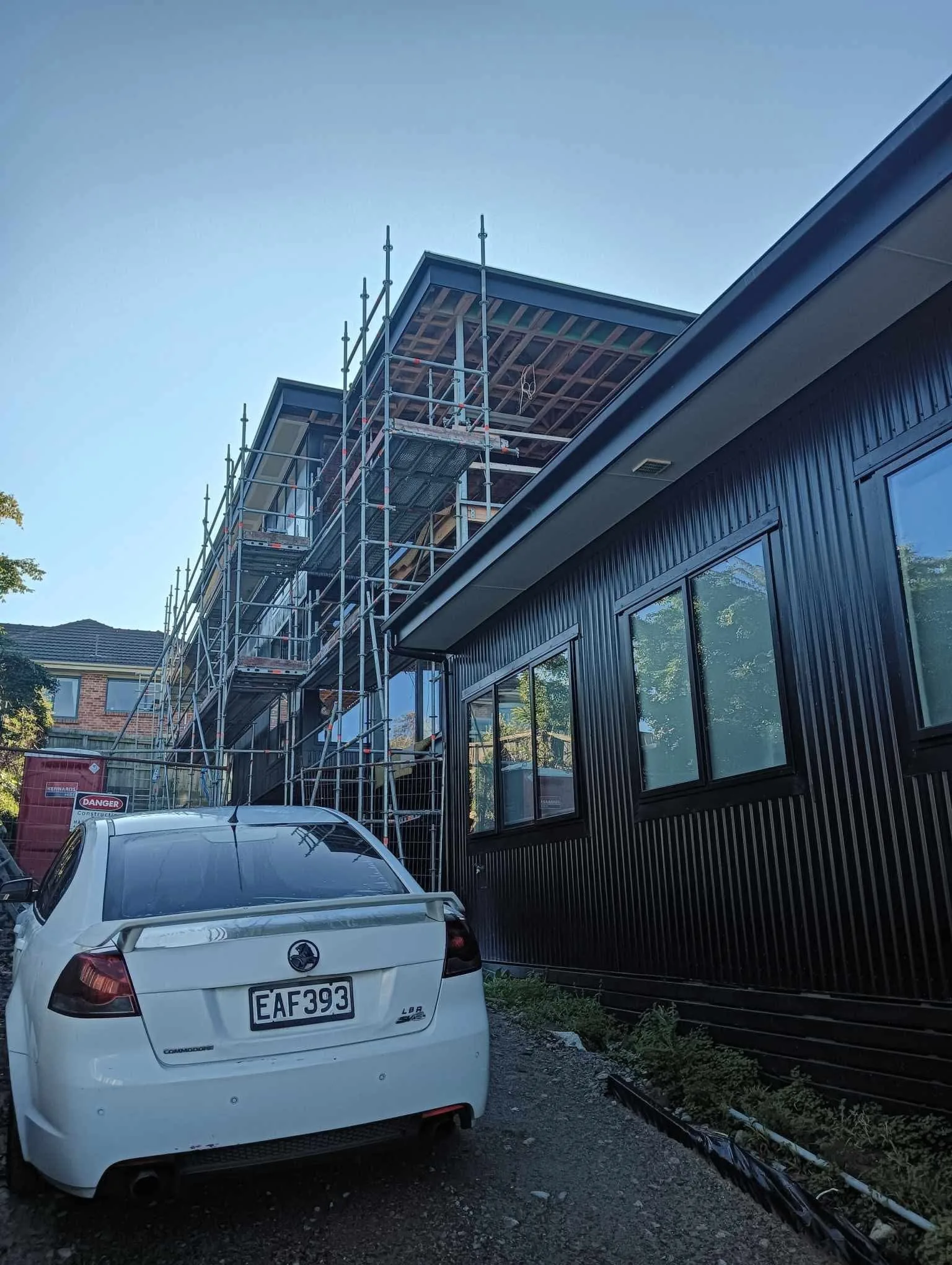 |
| Scaffold access set up against a clad building for exterior painting. |
Waikato weather sets the calendar
Through the cold months we get frost, fog and heavy dew before the sun is properly up, and summer swaps those for humidity. Damp cladding does not get coated. Outside work needs to wrap up early enough in the day that the coating is set before dew lands, and a shaded southern elevation stays wet long after the north face has dried.
Every product carries a data sheet setting out a minimum application temperature, a recoat time and the ventilation the coating needs. Cool or humid air stretches each of those rather than shrinking them. Touch dry is not the same as ready for service. Build lost days into the programme rather than hoping the weather behaves, and agree how a stoppage gets passed on.
Ask these before the order of works is locked in
- Has the roof been inspected, and does the written scope separate repairs from coating work?
- Are the spouting and downpipes clear, and whose job is that?
- What access equipment is needed, where does it stand, and for how long?
- Which elevations run in which order, and what has to stay open for customers and deliveries?
- Has any suspect older material been assessed before cleaning starts?
- Which one person is the site contact, and how will weather delays reach you?
Those six cover most of what our commercial painting brief for business owners asks a client to think through before a site visit.
FAQ
Can we paint the facade now and leave the roof until next year?
Yes, provided the roof assessment shows nothing is getting in. The test is not how the roof looks from the car park but whether fixings, flashings and drainage are sound. Where the roof is failing, new wall coatings age faster under the water still running down them, so the repair goes first even if the roof coating waits.
Who arranges the roofing repairs if the assessment finds a leak?
Usually the building owner or facilities manager engages a roofer directly, and the painting programme is built around that work. A painting contractor can set out what was found and where, so the roofing scope is specific rather than vague. Settle the repair in writing before coating dates are confirmed, because bringing access equipment back a second time pushes the whole programme out.
Does the order of works change if the building is tenanted?
The technical order stays the same: condition, repairs, drainage, then coatings. What changes is the timing inside each stage, because trading hours, deliveries and parking for every tenancy have to sit in the programme. Collect operating hours from each tenancy rather than working off an assumption, and agree which elevation runs in which week.
Commercial facade and roof programmes are run from the Claudelands base of Tomar Contracting Limited – Hamilton & Waikato, which works across Hamilton itself and out to Ngāruawāhia, Morrinsville, Cambridge and Te Awamutu. To have the order of works talked through before you commit to dates, the number is 0800 866 272, weekdays from 9 am to 5 pm. The rest of what the branch takes on is listed with Tomar Contracting Hamilton.


Comments
Post a Comment